
How Long Do Maine Coon Cats Live?
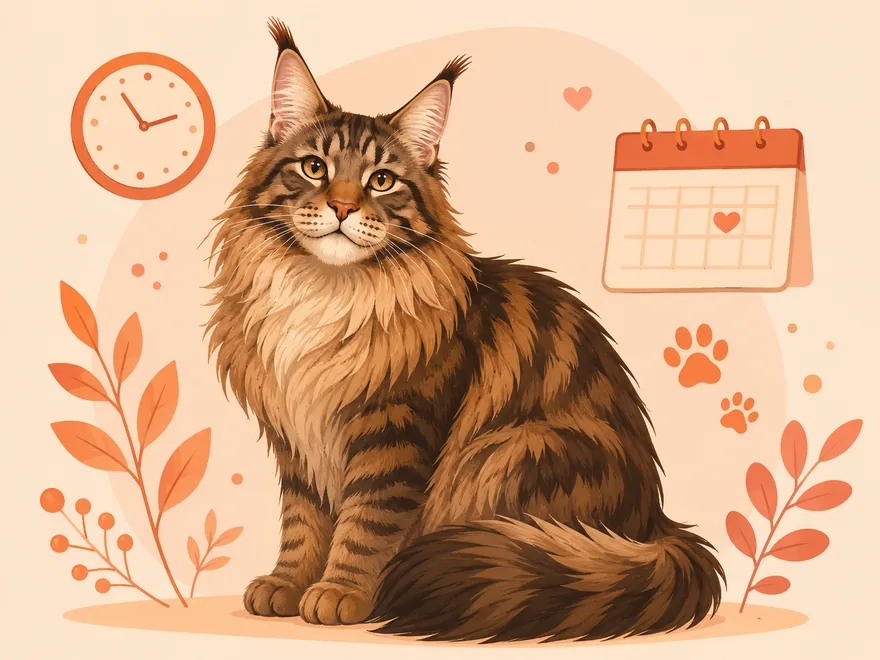
Maine Coon cats typically live 10 to 15 years. As a large breed they are prone to a few inherited conditions, mainly hypertrophic cardiomyopathy (HCM) and hip dysplasia, that can shorten that range. Indoor living, health screening from the breeder, an ideal body weight, and routine veterinary care all help a Maine Coon reach the upper end.
How long do Maine Coon cats live?
Maine Coon cats live 10 to 15 years on average. That sits a little below the typical range for mixed-breed house cats, which is mostly down to size: the Maine Coon is the largest pedigree cat breed, and that large frame carries a few specific health risks. For context on how long cats live in general, indoor cats average 12 to 18 years, and purebred cats tend to live around one to two years less than mixed-breed cats because of reduced genetic diversity. The Maine Coon's range sits right where you would expect a large purebred to land, not as an outlier.
A lifespan is a range, not a promise. Genetics, whether the parent cats were health-screened, body weight, and an indoor versus outdoor lifestyle all move an individual cat up or down within, and occasionally beyond, those 10 to 15 years. You can see how the Maine Coon compares with other cat breeds in our full lifespan chart.
What affects a Maine Coon's lifespan?
The biggest levers are the breed's inherited conditions, body weight, and lifestyle. Several of them are screenable or preventable.
- Hypertrophic cardiomyopathy (HCM). This is the most common heart disease in cats and the headline Maine Coon concern. A genetic mutation (MYBPC3) is associated with HCM in the breed. Most affected cats develop it after age 3, and some not until 6 to 8 years.
- HCM has incomplete penetrance. A cat carrying the mutation may never develop the disease, and a cat without it can still develop HCM, so a DNA result is one input rather than a guarantee. Responsible breeders screen breeding cats with both echocardiograms and DNA tests.
- Hip dysplasia. The breed's large, heavy build makes it prone to this hereditary joint condition, which can cause pain, stiffness, and reduced mobility as a cat ages.
- Spinal muscular atrophy (SMA). An inherited neurological condition that appears around 3 to 4 months and causes a swaying gait and muscle weakness. It is not painful and does not cause a severe loss of quality of life, but it does affect mobility. It is DNA-testable in breeding lines.
- Dental disease. Maine Coons can develop gingivitis early, so routine dental care protects long-term health.
- Body weight. Keeping a cat at an ideal body condition score of 4 to 5 out of 9 protects the heart and joints. Obesity shortens lifespan.
- Lifestyle. Indoor cats live far longer than outdoor-only cats, which average just 2 to 5 years. Spaying or neutering is also strongly tied to a longer life.
Maine Coon life stages
A Maine Coon passes through the same six feline life stages as any cat, but it matures more slowly. Where most cats reach adult size by 10 to 18 months, a Maine Coon can keep filling out until around age 3, so it is still in the Junior stage by the time many cats have finished growing. You can read more about the six feline life stages and where your cat fits.
- Kitten (under about 7 months) and Junior (about 7 months to 3 years): many Maine Coons stay on large-breed kitten food longer than other cats. Follow your breeder's or vet's guidance on when to switch.
- Adult (3 to under 7) and Mature (7 to under 11): age 7 is a good point to begin annual heart and weight monitoring, given the HCM and joint risks.
- Senior (11 to under 15) and Geriatric (15 and up): a Maine Coon enters its senior years around 11 on our scale, though veterinary guidelines class any cat as senior at about age 10. Senior wellness checks help catch age-related disease early.
Helping your Maine Coon live longer
Most of what extends a Maine Coon's life is preventable or screenable. The steps with the most impact target the heart, the joints, and body weight.
- Adopt or buy from lines where the parent cats are HCM-screened by echocardiogram and DNA test, and ideally SMA DNA-tested.
- Keep the cat indoors, or limit outdoor time to a safe enclosed space. The difference in indoor versus outdoor lifespan is large.
- Maintain an ideal body weight (body condition 4 to 5 of 9) to protect the heart and hips.
- Stay current on veterinary checkups, and add heart and joint monitoring from the Mature stage onward.
- Spay or neuter your cat, which is associated with a longer life.
Frequently asked questions
How long do Maine Coon cats live?
Maine Coons typically live 10 to 15 years. That is slightly below the average for mixed-breed cats, mainly because the breed's large size carries a few inherited health risks. Good genetics, indoor living, a healthy weight, and regular vet care help a Maine Coon reach the top of that range.
Why do Maine Coons have a shorter lifespan than some cats?
As a large purebred, the Maine Coon is prone to hypertrophic cardiomyopathy (a heart disease) and hip dysplasia, and purebred cats generally live around one to two years less than mixed-breed cats. Screening, weight control, and routine care offset much of that risk.
What do most Maine Coons die from?
Hypertrophic cardiomyopathy (HCM) is the breed's most significant health concern and the leading inherited disease that shortens lifespan. Hip dysplasia and dental disease are also common. Many of these are screenable or manageable with veterinary care.
Can a Maine Coon live to 18 or 20?
It is possible but not typical. The breed's average range is 10 to 15 years. Individual cats with healthy genetics, an ideal weight, indoor living, and good preventive care can occasionally exceed it, but there is no breed guarantee of reaching 18 to 20.
At what age is a Maine Coon a senior?
A Maine Coon enters its senior years around age 11 by our life-stage scale, though veterinary guidelines class any cat as senior at about age 10. Senior wellness checks from this point help catch age-related disease early, and the Mature stage at age 7 is a good time to start heart and weight monitoring.
Do Maine Coons grow slower than other cats?
Yes. Most cats reach adult size by 10 to 18 months, but Maine Coons can keep filling out until around age 3. Many stay on large-breed kitten food longer, so follow your breeder's or vet's guidance on the transition.
Is spinal muscular atrophy in Maine Coons painful or fatal?
No. Spinal muscular atrophy (SMA) appears around 3 to 4 months and causes a swaying gait and muscle weakness, but it is not painful and does not cause a severe loss in quality of life. Affected cats can live comfortably as indoor pets, and it is DNA-testable in breeding lines.
Does indoor living help a Maine Coon live longer?
Yes, significantly. Outdoor-only cats average just 2 to 5 years, while indoor cats live much longer. Keeping a Maine Coon indoors, along with spaying or neutering and maintaining a healthy weight, are among the strongest levers for a longer life.
Sources
- PetMD. Maine Coon breed health and longevity overview. petmd.com
- NC State University College of Veterinary Medicine. Maine Coon Cat Hypertrophic Cardiomyopathy (HCM), Veterinary Genetics service. cvm.ncsu.edu
- ASPCA Pet Health Insurance. Maine Coon Cat Facts. aspcapetinsurance.com
Written by the Cats Age Calculator editorial team · How we research & fact-check