
How Long Do Bengal Cats Live?
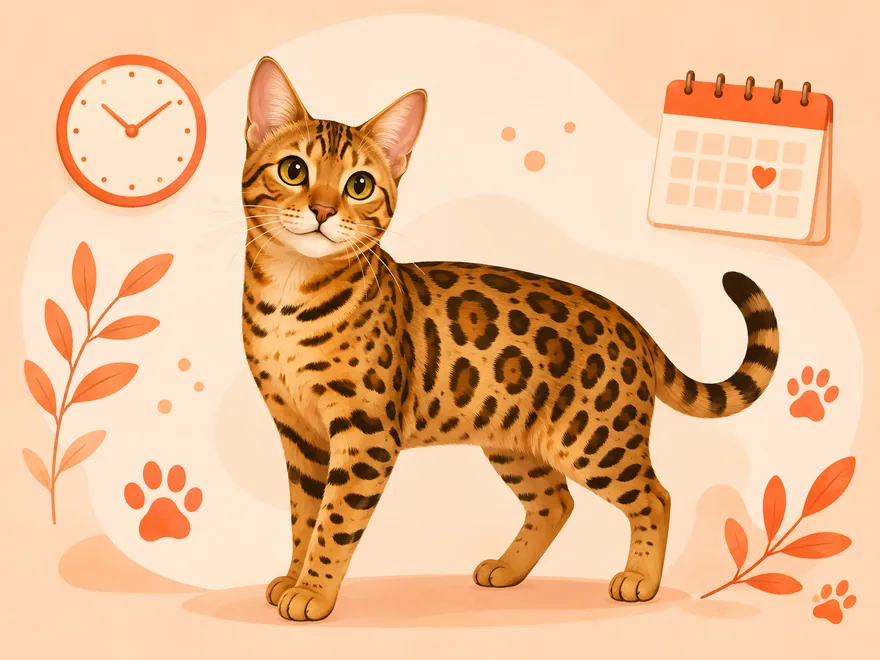
Bengal cats typically live 12 to 16 years. With early heart screening for hypertrophic cardiomyopathy (HCM), DNA testing for the breed's known recessive conditions, indoor living, and a healthy weight, many Bengals reach the upper end of that range, and some pass it. Genetics and routine veterinary care are the factors that matter most.
How long do Bengal cats live?
Bengal cats live 12 to 16 years on average, which places them in the middle of the range for purebred cats: a little below the longest-lived breeds, but solidly in the typical band for a healthy indoor cat. For context on how long cats live in general, indoor cats usually average 12 to 18 years, with some reaching 20, while outdoor-only cats average just 2 to 5 years. A Bengal's individual outcome depends mostly on genetics and on weight, dental, and preventive care. You can see how Bengals compare with other cat breeds in our full lifespan chart.
What affects a Bengal cat's lifespan?
The main factors are inherited disease, body weight, an indoor versus outdoor lifestyle, and routine veterinary care. Inherited disease is where Bengals differ most from a random mixed-breed cat.
- Hypertrophic cardiomyopathy (HCM). The most common heart disease in cats, in which the heart's muscular walls thicken and it works less efficiently. Cornell lists the Bengal among predisposed breeds. It is detected by echocardiography, and advanced cases can lead to heart failure, blood clots, or sudden death.
- Progressive retinal atrophy, Bengal type (PRA-b). An inherited, autosomal-recessive eye disease. Reduced low-light vision appears around 7 weeks of age and progresses toward blindness over the first year or so. Carriers are identified by DNA test, and carrier-to-carrier matings are not advised.
- Pyruvate kinase deficiency (PK-Def). An autosomal-recessive cause of anemia that is identifiable by a simple DNA test.
- Body weight. Keep a Bengal at an ideal body condition score of 4 to 5 of 9 to reduce strain and disease risk.
- Lifestyle. Indoor living dramatically outperforms outdoor life, where the difference in indoor versus outdoor lifespan is large. Spaying or neutering is also strongly tied to a longer life.
Reputable breeders echo-screen for HCM every year and DNA-test for PRA-b and PK-Def before breeding, so ask for results when getting a kitten.
Bengal life stages
The math that converts a cat's age to human years is the same for every breed, Bengal included, so we focus on what each of the six feline life stages tends to look like for this active, athletic cat rather than repeating a generic conversion chart.
- Kitten (under about 7 months): if present, PRA-b begins affecting low-light vision in this window, so this is the stage to confirm a kitten's DNA-test status.
- Junior (about 7 months to 3 years) and Adult (3 to under 7): prime years to begin annual HCM echocardiograms. Bengals are highly active and need plenty of enrichment.
- Mature (7 to under 11): middle age, when early signs of heart disease and weight creep deserve attention.
- Senior (11 to under 15) and Geriatric (15 and up): a Bengal enters its senior years around 11 on our scale, though veterinary guidelines class any cat as senior at about age 10. Senior wellness screening should be routine from then on.
Helping your Bengal live longer
Most of what extends a Bengal's life is preventable or screenable, and the steps with the most impact center on the heart.
- Schedule annual cardiac echocardiograms with a veterinary cardiologist, since HCM is often silent until it is advanced.
- Keep your Bengal indoors, or limit outdoor time to a secure enclosed space.
- Maintain an ideal body weight (body condition 4 to 5 of 9) with measured portions.
- Keep up dental care and routine senior wellness exams from about age 10.
- Choose kittens from breeders who DNA-test for PRA-b and PK-Def and echo-screen the parents for HCM.
Frequently asked questions
How long do Bengal cats live?
Bengal cats typically live 12 to 16 years. Indoor Bengals that stay at a healthy weight and get regular veterinary care often reach the top of that range, and some live longer.
Do Bengal cats have more health problems than other cats?
Bengals have three well-documented inherited conditions: hypertrophic cardiomyopathy (HCM), progressive retinal atrophy (PRA-b), and pyruvate kinase deficiency (PK-Def). All three can be screened or DNA-tested, so responsible breeding and early heart checks reduce the risk a lot.
What do most Bengal cats die from?
The most significant breed-linked risk is hypertrophic cardiomyopathy, a thickening of the heart muscle that is often silent until advanced and can lead to heart failure, blood clots, or sudden death. This is why annual cardiac screening matters for Bengals.
Can a Bengal cat live to 20?
It is possible but not typical. The expected range is 12 to 16 years; reaching 18 to 20 is an outlier that depends heavily on genetics, indoor living, a healthy weight, and consistent veterinary care.
Do indoor Bengals live longer than outdoor Bengals?
Yes, substantially. Indoor cats generally average 12 to 18 years, while outdoor-only cats average just 2 to 5 years because of traffic, predators, disease, and fights. Keeping a Bengal indoors is one of the biggest lifespan factors.
At what age is a Bengal cat considered senior?
Veterinary guidelines class a cat as senior by about age 10. A Bengal in the 11-to-under-15 band is in its senior years, so routine senior wellness exams should be standard from roughly age 10 onward.
How can I help my Bengal live longer?
Keep them indoors, maintain a lean body condition (4 to 5 of 9), schedule annual heart echocardiograms, stay current on dental and preventive care, and spay or neuter, which is associated with longer life.
Does a Bengal's larger size make it age faster?
No. Cat age conversion is the same for every breed and size; there is no size adjustment for cats. A Bengal ages on the same human-year curve as any other cat regardless of how big it is.
Sources
- Cornell Feline Health Center, College of Veterinary Medicine, Cornell University. Hypertrophic Cardiomyopathy. vet.cornell.edu
- Wisdom Panel (Mars Petcare). Progressive Retinal Atrophy, Bengal (PRA-b). wisdompanel.com
- PetMD. Bengal breed health and longevity overview. petmd.com
Written by the Cats Age Calculator editorial team · How we research & fact-check